

On this page:
IELTS Listening Test
In this lesson, you will learn:
- how the IELTS Listening test works
- how to avoid common listening mistakes
- how to improve your listening techniques
- and how to answer different question types accurately.
The Listening module is the first part of the IELTS exam, and it assesses your ability to understand spoken English, including detailed factual information, main ideas, opinions, and the purpose of the speakers. The test consists of four sections with a total of 40 questions (10 questions in each section). You will hear a recording of a conversation or a monologue featuring a range of native English accents.
The Listening test is the same in both the Academic and General Training versions of IELTS and lasts approximately 30 minutes. If you take the paper-based version (IELTS on paper), write your answers on the question paper while listening, and you will be given 10 extra minutes at the end to transfer your answers to the answer sheet. Your answers must be written in pencil. If you take the computer-delivered version (IELTS on computer), you type your answers directly on the screen, and you will have 2 minutes at the end to check your answers.
IELTS LISTENING PREPARATION TIPS
The most important factor in preparing for the IELTS Listening test—and feeling confident and calm on exam day—is consistent, focused practice. Your practice should have a clear purpose. You can either work on improving your listening skills by focusing on different question types, topics, and accents, or you can practise under real exam conditions to identify your weaknesses and check how close you are to your target band score.
Listening Comprehension Practice
If you have difficulties with listening comprehension, it’s essential to practise active listening — that is, fully concentrating on what the speaker is saying rather than passively hearing the words.
To develop active listening, start with a short listening practice task and listen to it carefully from beginning to end to understand the overall context. Then replay the audio and try to write down everything you hear, pausing the recording sentence by sentence. Finally, compare your sentences with the audio script and identify your mistakes or weaknesses.
Some English learners rely on films, video games, or music to improve their listening skills. These can be enjoyable, but they’re not enough on their own. To truly improve, you need to expose yourself to a range of listening sources, such as podcasts, which help you learn new vocabulary, explore different topics, and get used to a variety of accents.
Accents
IELTS is an international test, and you will hear a range of voices and native speaker accents, including British, Australian, New Zealand, American, and Canadian. However, the most commonly used accents are British and Australian. If you find it difficult to understand certain accents — especially British English — you should practise listening to them more regularly.
Use Reliable Tests
In the IELTS Listening test, you will hear each recording once only, so it’s essential to stay focused and listen carefully at all times. Practise listening to each test just once. If this feels difficult at first, you can listen to different tests several times, but eventually you should reduce the number of repetitions until you can complete the whole test after listening only once.
Once your listening comprehension improves and you can understand the speakers without much difficulty, start completing standard IELTS Listening practice tests. These will help you familiarise yourself with different question types, learn the strategies they require, and develop the skills needed for a high score. Although each question type has its own techniques, you will naturally develop your own methods by analysing your correct and incorrect answers.
If you struggle with a particular question type — for example, multiple-choice questions — focus on that type and practise it more frequently until you achieve the results you want.
Remember: avoid non-standard or unofficial practice tests. As mentioned earlier, the most reliable materials are published by Cambridge, as they are based on authentic question types used in previous IELTS exams.
Exam Conditions Matter!
Complete the entire practice test under real exam conditions. Make sure your environment is quiet and comfortable so you won’t be distracted while working through the test. To get an accurate result, disable auto-correction if you’re using a laptop or any other device, and do not use any dictionaries or online sources.
Practice Performance
Finally, to improve your listening band score and identify your weakest areas, track your practice performance. Create a table like the one below, including the date, the test name and number, your correct answers, your band score, and any areas of weakness.
Listening practice performance
| Date | Test | Correct Answers | Band Score | Weakest Areas |
| July 16 | Cambridge 17- Test 1 | 23 | 6 | Spelling, Matching, MCQs |
| July 18 | Cambridge 17- Test 2 | 25 | 6 | Matching, MCQs |
| July 21 | Cambridge 17- Test 3 | 26 | 6.5 | MCQs |
| July 23 | Cambridge 17- Test 4 | 31 | 7 | None |
IELTS Listening Band Scores
The Listening test is marked by trained and certified markers who are regularly monitored to ensure reliability. After being marked, all answer sheets are further analysed by Cambridge English. Each of the 40 questions is worth one mark, which means you receive one point for every correct answer.
Your score out of 40 is then converted to the IELTS 9-band scale, and results are reported in whole or half bands. The table below shows the approximate Listening band score based on the number of correct answers. For example, if you need Band 7 in Listening, you should aim to answer at least 30 questions correctly.
IELTS Listening Score Chart
| Correct Answers | Band Scores |
|---|---|
| 39–40 | 9.0 |
| 37–38 | 8.5 |
| 35–36 | 8.0 |
| 32–34 | 7.5 |
| 30–31 | 7.0 |
| 26–29 | 6.5 |
| 23–25 | 6.0 |
| 18–22 | 5.5 |
| 16–17 | 5.0 |
| 13–15 | 4.5 |
| 10–12 | 4.0 |
| 8–9 | 3.5 |
| 6–7 | 3.0 |
IELTS Listening Test Format
There are four sections with ten questions each, and each recording lasts about 4–6 minutes. As a test taker, you need to know what you are going to face in each section. This will help you follow the recordings more easily and write your answers accurately.
The first two sections focus on situations set in everyday social contexts.
Section 1 is a conversation—often a telephone conversation—between two people in an everyday situation, such as making travel arrangements, organising a place on a course, or booking a hotel room. You need to listen for specific details, including names, places, dates, times, and numbers. Uncommon names or places will usually be spelled for you.
In Section 2, you will hear a monologue (one speaker) in a similar everyday context. This is often a talk from a guide, and you may hear information about a building, a resort, a company, local facilities, and so on.
The final two sections relate to educational or training situations.
Section 3 is a conversation between up to four speakers in an academic context. It may involve university students discussing a project, a tutor guiding a discussion, a student presenting their ideas to classmates, or a group planning research together.
Section 4 is an academic lecture delivered by a single speaker (monologue).
Now, let’s review the similarities and differences between the sections:
- Sections 1 and 3 are conversations.
- Sections 2 and 4 are monologues.
- Sections 1 and 2 deal with everyday social contexts.
- Sections 3 and 4 focus on academic contexts.
The sections become increasingly difficult as the test progresses. This means Section 1 is usually the easiest, and Section 4 is the most challenging part of the Listening test.
| IELTS Listening Sections | Recording | Context | Examples |
| Section 1 | conversation | everyday social context | booking, making arrangements |
| Section 2 | monologue | everyday social context | tour, information section, general talk |
| Section 3 | conversation | academic discussion | students discussing a project |
| Section 4 | monologue | academic lecture | university lecture or seminar |
IELTS LISTENING EXAM TIPS
This lesson is very important for achieving a high band score in the Listening test. We’ll share some practical tips and techniques to help you improve your performance, build your confidence, and manage stress more effectively on test day.
Follow Instructions
At the beginning of each section of the Listening test, you will hear a short introduction that tells you about the situation and the speakers. This information is not usually part of the questions, so don’t skip it. The introduction helps you understand who the speakers are, what they are going to talk about, and where the conversation is taking place. This prepares you to follow the rest of the recording more effectively.
For example, you might hear something like this:
While listening to the introduction, read the instructions carefully. After the introduction finishes, you will have some time to look through the instructions and questions.
Different sections may include different question types, and each type has its own set of instructions.
In the first three sections of the test, there is a short break in the middle, allowing you to look at the remaining questions before the recording continues.
Section 4, however, has no break between Questions 31 and 40. You will be given time only at the beginning of Section 4 to look at the last ten questions.
Now, let’s see how to use this time to approach the upcoming questions. For example, in Section 1, you may hear something like this:
At this point, you need to read the instructions very carefully and highlight any important information, such as the number of words you are allowed to write, whether you should choose a letter, or whether you need to write words to complete sentences, etc. Remember, if you do not follow the instructions, you will lose the mark, even if the information you give is correct.
Skipping the instructions is quite common, even among experienced test takers, because they assume they already know the question types and what to do. However, you must be very careful, as the instructions can sometimes be tricky. For example, do you have to write letters or words? The answer depends on the instructions.
Consider this example:
Questions 7–10
Which counsellor should you see?
Choose FOUR answers from the box and write the correct letter, A–D, next to Questions 7–10.
| A | Jack Robson |
| B | Alice Ford |
| C | Sarah Conner |
| D | Michael Danby |
| E | Maria Hemingway |
7 if your concerns are related to anxiety
8 if it is your first time seeing a counselor
9 if you don’t have an appointment
10 if you are unable to see a counselor during normal office hours
As you can see in the instructions, you must write a letter, not words, as your answers. If the answer to Question 7 is B, and instead of “B” you write “Alice Ford” or “B / Alice Ford”, your answer will be marked wrong, even though the information is technically correct. Based on the instructions, the answer to Question 7 must be B only.
In Multiple Choice Questions (MCQs), you may sometimes need to choose more than one letter. Look at this example:
Questions 13–14
Choose TWO letters, A–E.
Which TWO things are most popular among users?
A. Children’s books
B. Textbooks
C. Computer games
D. Toys
E. Tools
Here, you must choose two answers for Questions 13 and 14. You can write your answers in either order. For example, if the correct answers are B and E, you may write B for 13 and E for 14, or the other way around.
Word-Limit Tips
Another important part of the instructions is the word limit. You must pay close attention to it at all times, as your answer will be marked wrong if you exceed the limit. In the IELTS Listening test, the maximum number of words you are allowed to write is usually three. This means that if the limit is “NO MORE THAN THREE WORDS”, you may write one, two, or three words — but four or more words will definitely be incorrect.
Now, let’s look at some useful strategies for staying within the word limit.
Complete the sentences below.
Write NO MORE THAN ONE WORD for each answer.
He has a (1) …………… job and also studies at the university.
Audioscript
– By the way, what does your nephew do?
– He’s a university student and currently works as a waiter part time, I think.
If your answer is “part time”, it is correct in meaning, but the way you write it matters. If you write it as two separate words, you exceed the “ONE WORD” limit and the answer becomes wrong. In this case, you can put a hyphen (–) between the two words to form a hyphenated compound noun, which counts as one word: part-time.
👉 He has a (1) …part-time… job and also studies at the university.
Examples of hyphenated compounds that count as one word:
- He has a part-time job.
- They hired a full-time worker.
- She is committed and well-organised.
- They should study up-to-date cases.
- A nineteen-year-old girl was seriously injured.
Now, look at this example:
Complete the summary below.
Write NO MORE THAN TWO WORDS for each answer.
Students must submit their assignments before the deadline and (31) ……………. a study session without a plan.
Audioscript
As mentioned earlier, students need to turn in their assignments before the deadline. Furthermore, they cannot start a study session without a strategy.
In this example, the correct answer is “cannot start”, which can also be written as “can’t start” to fit the word limit. Note that, apart from the word limit, writing “can not” as two separate words is grammatically incorrect and must be written as one word: “cannot.”
👉 Students must submit their assignments before the deadline and (31) …cannot start… a study session without a plan.
In the same way, “must not start” should be written as “mustn’t start” if the word limit is NO MORE THAN TWO WORDS.
Let’s look at another example:
Complete the sentences below.
Write NO MORE THAN TWO WORDS for each answer.
It was not a serious accident; the (17) ………..… was the only thing damaged.
Audioscript
– Oh, she had an accident yesterday. Is she OK?
– Fortunately, she braked in time, and nothing serious happened. Only the light on the car was damaged.
In this example, the phrase “the light on the car” contains five words. Some test takers may try to write only “light” to avoid exceeding the word limit, but you can simply reorder the words without changing the meaning. The correct answer is “car light”, which fits the two-word limit and accurately reflects the information given.
👉 It was not a serious accident; the (17) …car light… was the only thing damaged.
Another common question from candidates is: Do I have to write articles and prepositions?
The answer is: It depends on the question type. Look at this example:
Complete the table below.
Write NO MORE THAN ONE WORD for each answer.
| Where (to visit): | (1) ……………… |
| Visiting Time: | (2) ……………… |
Audioscript
– You didn’t show up. Where were you last night?
– I went to the hospital to visit my uncle.
In form or table completion tasks, you can omit articles and prepositions if the word limit does not allow for extra words. In this example, the correct answer is simply “hospital”, without “the”.
| Where (to visit): | 👉 (1) …hospital… |
| Visiting Time: | (2) ……………… |
But when you are completing a sentence, grammar matters.
Complete the sentences below.
Write NO MORE THAN TWO WORDS for each answer.
He went to (14) ……………………. to see his uncle.
Audoscript
– You didn’t show up. Where were you last night?
– I went to the hospital to visit my uncle.
In this case, you must include the article to make the sentence grammatically correct. The answer is “the hospital.”
👉 He went to (14) …the hospital… to see his uncle.
This is one of the most common mistakes among test takers: they forget to write articles, prepositions, or other “important pieces of information” that appear in the recording.
Look at this example:
Complete the sentences below.
Write NO MORE THAN THREE WORDS for each answer.
She exercises in the gym for (18) ……………..… a day.
Audioscript
– What’s her schedule like?
– As far as I know, she goes to the gym and works out for around two hours daily.
Some test takers write “two hours” as the answer. So which one is correct: “two hours” or “around two hours”?
It depends on the answer key.
IELTS often shows the key like this:
(around) two hours
This means both “two hours” and “around two hours” are accepted.
But sometimes the answer key is simply:
around two hours
In that case, only “around two hours” is correct.
👉 She exercises in the gym for (18) …around two hours… a day.
THE GOLDEN TIP
Include all the information you hear as long as it fits within the word limit.
So if the limit is three words, the best answer here is “around two hours.”
If the limit is two words, then the only possible answer is “two hours.”
Including complete information—when allowed—reduces the risk of losing marks.
Another situation you may come across in this question type involves numbers.
Look at this example:
Complete the sentences below.
Write NO MORE THAN ONE WORD AND / OR A NUMBER for each answer.
She exercises in the gym for (18) ……………..… a day.
If you write “two hours”, your answer is accepted. However, it’s usually safer to write the number as a digit, because if you misspell a number word, your answer will be marked incorrect.
For example, the number four is spelled F-O-U-R, but some candidates mistakenly write “fourty”, which is wrong. The correct spelling is “forty.”
To avoid spelling mistakes like this, it is often better to write numbers as numerals, not words.
👉 She exercises in the gym for (18) …2 hours… a day.
Test takers sometimes get confused when numbers appear in the instructions. If the limit is ONE WORD AND/OR A NUMBER, then a date such as 2021 counts as one number, and it is better to write it in digits rather than in words (twenty twenty-one).
Similarly, a large number like 9,000,000 is counted as one word when written as a numeral. Based on the instructions, you may write it as 9,000,000 or as 9 million (which is one number + one word).
Now, let’s look at another tricky situation:
Complete the sentences below.
Write NO MORE THAN TWO WORDS for each answer.
She exercises in the gym for (18) ……………..… hours a day.
Audioscript
As far as I know, she goes to the gym and works out for around one or two hours daily.
In this example, the phrase “one or two” contains three words, so writing it exactly as spoken would exceed the word limit. To stay within the limit, you can use a slash between the options and write the answer as:
👉 She exercises in the gym for (18) …one/two… hours a day.
This keeps the meaning accurate while fitting the two-word limit.
On the other hand, a question may already include the word “or” between two possible answers.
Complete the sentences below.
Write NO MORE THAN TWO WORDS for each answer.
She exercises in the gym for (18) ……..… or …..…… hours a day.
Pay close attention when checking your answers. In this type of question, you are expected to provide two possible answers for one item. If you’re taking the paper-based test, you can write the two words with a comma between them on the answer sheet:
👉 18- …one,two…
If you’re taking the computer-delivered test, you simply type one word in each gap.
👉 She exercises in the gym for (18) …one… or ….two… hours a day.
In some IELTS Listening questions, you may see symbols instead of full words. Many test takers worry about whether symbols count toward the word limit. The good news is that they don’t.
Symbols are not counted as words in IELTS Listening:
- % (percent sign)
- $ £ € (currency symbols)
- ’s (apostrophe S)
- a.m. / p.m.
- the suffixes used for ordinal numbers (1st, 32nd, 43rd)
This means you can safely include them without breaking the word limit.
For example:
- 50% counts as one number/word.
- $50.25 counts as one number/word.
- 10 a.m. counts as one number/word.
- 23rd November counts as one number + one word.
Understanding how symbols work will help you avoid unnecessary mistakes and stay within the word limit.
IELTS Listening Techniques
Highlight
After identifying the question type and reading the instructions, you should highlight the important information. Then, read the questions carefully and highlight the keywords that help you identify the information you need to listen for.
If you are taking the paper-based test (PBT), underline the keywords.
If you are taking the computer-delivered test (CDT), you can select any part of the text, right-click, and choose Highlight.
You may not hear the exact words you highlighted, because speakers usually use synonyms or paraphrased expressions rather than repeating the same wording from the questions. However, highlighting the keywords helps you follow the speaker more easily and prevents you from losing your place in the recording.
Look at this example:
Complete the sentences below with NO MORE THAN ONE WORD for each answer.
| 6. The girl is a ………………….., that’s why she loves animals. 7. Although the girl is not a vegetarian, she does not eat a lot of meat. Her favorite food is ………………….. 8. The girl has given up playing handball. Now, she just plays ………………….. with her friends at weekends. |
Predict
After highlighting the important parts of the instructions, read the questions carefully — for example, Questions 6 to 8 in this sample — and highlight or underline the keywords. While doing this, try to predict the type of answer that will fit in each gap.
Predicting the answer helps you understand what kind of word you are listening for.
For example:
- Is the answer likely to be a noun or an adjective?
- Is it a number, a date, or a place?
- Should it be singular or plural?
When you have a good idea of what to expect, it becomes much easier to recognise the correct answer when you hear it.
Take Question 6 as an example:
Complete the sentences below with NO MORE THAN ONE WORD for each answer.
6. The girl is a ………………….., that’s why she loves animals.
the answer must be a noun, because the word limit is one word and the gap follows the article “a”. This also tells you the word should begin with a consonant sound, not a vowel sound. Finally, because the article is singular, the answer must also be singular, not plural.
In some question types — especially Multiple Choice Questions (MCQs) — you will see several answer options. When preparing for these, make sure you highlight keywords only in the questions, not in the options.
There are two reasons for this:
- Time is limited. You won’t have enough time to highlight keywords in every option.
- Too much highlighting becomes confusing. If you highlight everything, you won’t know what to focus on while listening.
Also, remember that in MCQs, you will usually hear all of the options mentioned in the recording — not just the correct one. This is why you must listen carefully and decide which option actually matches the keywords in the question.
Look at this example:
Answer the questions below. Choose the correct letter, A, B, or C.
12. How long has the fitness app been operating?
A. about 3 weeks
B. about 3 months
C. about 6 months
Audioscript
FitTrack Pro is a new health and exercise app. The developers spent three months designing the first version, and it has now been in use for around half a year.
As you can hear, the speaker mentions both “three months” and “half a year,” which correspond to options B and C. However, the question asks “How long has the fitness app been operating?” — and the phrase “…has now been in use for around half a year” answers that directly.
👉 Therefore, the correct answer is C.
Always Focus
While listening to the recording and trying to pick up answers, some candidates lose focus. For example, they may get stuck on a difficult question and then lose their place in the recording.
You must never lose your concentration during the Listening test. Stay focused and follow the speaker closely at all times.
Remember, the answers always appear in order. The answer to Question 1 comes before the answer to Question 2, and so on. If you miss an answer, do not stop and think about it. Move straight on to the next question.
For instance, if you are waiting for the answer to Question 5 but the speaker has already moved on to information related to Questions 6 or 7, forget about Question 5 and focus on the current part of the recording. Otherwise, you risk losing your place and missing several more answers.
Trying too hard to recover one mark can cause you to lose two or three more. Always follow the speaker and keep moving forward.
Similarly, never get stuck on a question if you have doubts about your answer, spelling, grammar, or the word limit while you are listening. You simply don’t have time to think about these during the recording. Make your best guess, write something down, mark the question, and move on.
Your main focus should always be listening to the recording and following the speaker.
Between recordings, there is often a short break that allows you to check your answers. Use that moment to review any questions you marked earlier. However, if you feel confident about your previous answers, avoid spending this limited time rechecking them. Instead, use the break to read ahead and prepare for the upcoming questions.
Don’t worry if you still have doubts about some answers. At the end of the test, you will have 10 minutes in the paper-based test to transfer your answers and review them. In the computer-delivered test, you will have 2 minutes to check your answers. During this time, check:
- whether your answer fits the information given
- the spelling
- the word limit
- and the grammar, if the task requires a grammatically complete phrase
Sometimes, while listening and trying to pick up answers, you may hear difficult words in either the questions or the recording, and some candidates lose their concentration because of this. To stay focused, don’t try to understand every single word. IELTS recordings often include extra information and challenging vocabulary to test your comprehension, but most of it is not needed for the answers.
Focus only on listening for the answers, not understanding everything.
Also, never leave a question blank. Make your best guess and write something, because you may still get it right and increase your score. When guessing, don’t worry about being wrong — IELTS does not penalise you for incorrect answers.
A gap? Don’t panic!
In some parts of the test, the speaker may continue talking for a while without giving any answers, and it can become difficult to track where you are in the recording. This often happens when there is a gap between answers, and it’s especially common in Section 4.
For example, imagine you have already answered Questions 31 to 35, and you are now waiting for the answer to Question 36. The speaker keeps talking non-stop, but nothing matches Question 36 yet.
Don’t panic — this simply means there is a natural gap between those questions.
In this situation, look back at the highlighted keywords in Question 36. Then quickly check the keywords in Question 37 to make sure you haven’t lost your place. If the speaker is not talking about either of those topics yet, just stay calm and keep listening.
When the speaker finally mentions the keywords in Question 36, you can pick up the answer confidently.
Multitasking
On the other hand, some answers may appear very quickly. You might hear two or three answers in a short amount of time. When this happens, you need to multitask — in other words, use several skills at the same time so you can write your answers quickly without missing anything.
Multitasking is extremely important in the Listening test. You must be able to:
- read the question,
- listen for the answer,
- write your answer down,
- and read the next question
all at once.
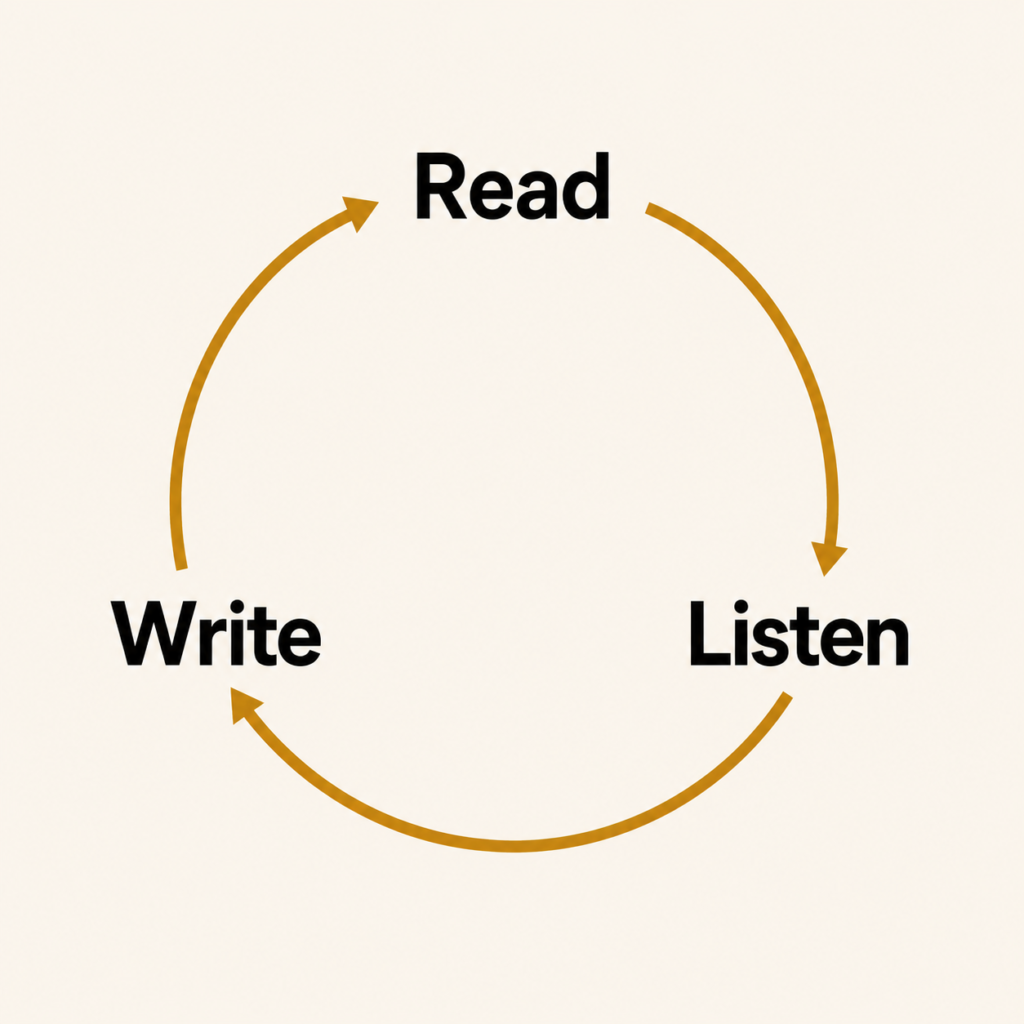
If you hear the answer to a question, don’t spend too much time focusing on writing it neatly. You need to keep listening for the next answer while also glancing at the highlighted keywords in the upcoming question. This helps you avoid missing the next part of the recording.
To save time while multitasking, you can use short forms or abbreviations when writing your answers during the recording. For example, instead of writing “international students”, you might quickly jot down “int sts” and mark the question.
Just remember to write the full words during the extra checking time at the end — otherwise, you will lose the mark.
Distractors
Sometimes it may seem like there is more than one possible answer, and this can confuse candidates. When you are listening for answers, you must be aware of distractors. The first thing you hear is not always the correct answer.
In IELTS Listening, it is very common for speakers to change their minds, correct themselves, or offer additional details. So while you are writing your answer, keep listening carefully and be ready for the speaker to adjust or replace the information.
Complete the notes below.
Write NO MORE THAN TWO WORDS for each answer.
Most favourite attraction: (7) ……………..
Audioscript
– How was your trip, by the way? Which part of the city did you like the most?
– Once we got there, we were really impressed by the museum — the building was beautifully designed and decorated. However, it wasn’t as stunning as the Opera House; the interior was unbelievably magnificent.
If you write “museum” as your answer, keep listening. When you hear words such as “however,” “but,” or “although,” the speaker may be changing the answer. In this case, the correct answer is “Opera House.”
👉 Most favourite attraction: (7) …Opera House…
Sometimes the speaker may mention two or three possible answers, and it may not be immediately clear which one is correct.
Don’t get stuck — just write down all the possible options and mark the question. You can decide later.
Here’s a useful tip:
Often, the same speaker or another speaker will confirm the correct answer a few seconds later. If something is repeated or emphasised, it is very likely the answer. Make sure you don’t miss this confirmation.
Complete the sentences below.
Write NO MORE THAN ONE WORD for each answer.
In Canada, the most attractive city to visit is (9) ……………… .
Audioscript
– I’ve heard great things about Canada. Which city in your country is the most captivating place to visit?
– I personally think Vancouver is the best place to see, but a lot of people say Toronto.
At this point, you’ve heard two possible answers: Vancouver and Toronto. Since you don’t yet know which one is correct, write both (Vancouver / Toronto) and mark the question.
In Canada, the most attractive city to visit is (9) …Vancouver / Toronto?… .
You must keep listening rather than trying to decide immediately.
Audioscript
– Yeah, you’re right. I’ve read a lot of comments from tourists online, and most of them agreed on Toronto.
Here, the speaker clearly confirms the answer.
So delete “Vancouver” and keep “Toronto” as your final answer.
👉 In Canada, the most attractive city to visit is (9) …Toronto… .
Having two possible answers for one question can also be challenging in map labelling. Candidates often struggle when the speaker mentions several possible places before confirming the correct one. Let’s look at an example to understand how to approach this question type effectively.
Look at this example:
Label the map below.
Write the correct letter, A–E, next to Questions 11–15.
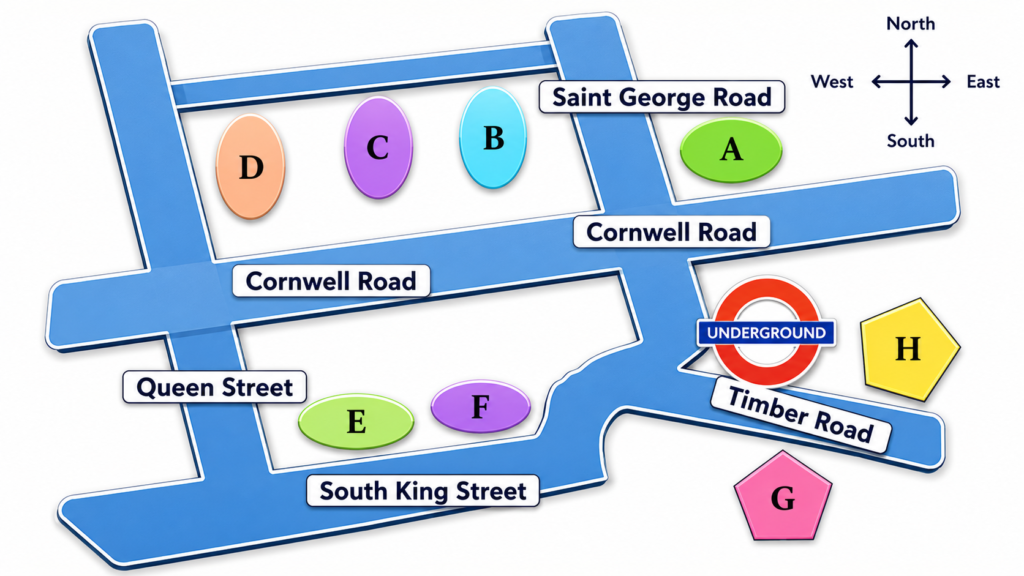
11. Science Museum ………
12. National History Museum ………
Audioscript
The first site is my favourite — the Science Museum — which is on the corner of Saint George Road. If you haven’t visited it yet, I encourage you to go before the busy season.
At this point, both A and B appear to be on the corner of Saint George Road, so you should write down both possibilities (A / B) for Question 11 and mark the question.
11. Science Museum …A/B?…
12. National History Museum ………
Your final answer will depend on what you hear next.
In map labelling, it’s common for speakers to mention two or three possible locations before narrowing it down. That’s why you must keep listening rather than choosing too early.
Audioscript
… I encourage you to go before the busy season. Just west of the Science Museum is the National History Museum. It’s a place you really shouldn’t miss.
The phrase “just west of the Science Museum” is the key.
“Just west of” means directly beside, with nothing in between.
Looking at the map:
- The location directly west of the Science Museum (A/B area) is marked with the letter B.
- The National History Museum is immediately next to it, at letter C.
Therefore:
- The correct answer to Question 11 (Science Museum) is B.
- The correct answer to Question 12 (National History Museum) is C.
👉 11. Science Museum …B…
👉 12. National History Museum …C…
Tips for Map Labelling
Always note the compass directions (north, south, east, west) on the map before the recording begins.
Listen for common phrases such as:
- “on the corner of…”
- “directly opposite…”
- “just south of…”
- “next to…”
- “between X and Y…”
If two locations seem possible, write both, mark the question, and wait for confirmation.
Pay special attention to words like “just,” “directly,” “immediately,” “at the end of,” and “past.”
The final confirmation is almost always clear — don’t guess before you hear it.
Never Rephrase
In the IELTS Listening test, you must write the exact words you hear in the recording.
Complete the sentences below.
Write NO MORE THAN TWO WORDS for each answer.
It was not a serious accident; the (17) ………..… was the only thing damaged.
Audioscript
– Oh, she had an accident yesterday. Is she ok?
– Fortunately, she braked in time, and nothing serious happened. Only the light on the car was damaged.
If you hear the word “car” in the recording and you write “vehicle” instead, your answer will almost certainly be marked wrong.
Write exactly what you hear — Never change or rephrase the answer unless you have to.
👉 It was not a serious accident; the (17) …car light… was the only thing damaged.
Look at this example:
Complete the notes below.
Write NO MORE THAN ONE WORD AND / OR A NUMBER for each answer.
Appointment time: (6) ……………..
Audioscript
– So, let’s sort this out as soon as possible. What time can we meet tomorrow?
– How about at 4 p.m.?
– I need to pick up my sister from school. Could we push it back by an hour, please?
Here, the speaker never literally says “5 p.m.” — but the answer is still 5 p.m.
We understand it from the meaning:
4 p.m. + 1 hour later = 5 p.m.
👉 Appointment time: (6) …5 (p.m.)…
This is one of the few situations where you may write something the speaker does not say word for word. As long as it is logically correct and follows from the conversation, your answer will be accepted.
Spelled Answers
In the IELTS Listening test, uncommon or less familiar words are usually spelled out for you. For example, if the answer is “London,” it won’t be spelled because English learners are expected to know it. But if the answer is “Whitby,”the speaker will spell it for you: W-H-I-T-B-Y.
You must have good spelling, because any misspelled answer will be marked incorrect.
Many English learners struggle with certain letters. For example:
Some find it difficult to distinguish “g” /dʒiː/ and “j” /dʒeɪ/.- Some find it difficult to distinguish “g” /ji:/ and “j” /jey/.
- In some British accents, the letter “r” can sound like /ɑː/, and test takers sometimes write “a” or “o” instead of “r.”
- In some languages, including Turkish and Azeri, the letter “i” is pronounced like “e” /iː/ (like in “bee”), so under pressure, some candidates write “i” instead of “e” when they hear that long /iː/ sound.
When a word or number is being spelled in the recording, write it down immediately as the speaker spells it. Don’t wait until they finish spelling and then try to remember it later — you might forget one of the letters.
Finally, don’t worry about choosing between British and American spelling, because IELTS accepts both, as long as the spelling is correct.
Sometimes, instead of spelling a word, speakers may give you a clue or a description to help you identify the correct spelling. Look at this example:
Complete the notes below.
Write NO MORE THAN ONE WORD AND / OR A NUMBER for each answer.
Last name: (6) ……………..
Audioscript
– Excuse me, what’s your last name, please?
– My last name is Day — the opposite of night.
In this case, the speaker doesn’t spell the name, but the clue “the opposite of night” clearly tells you that the answer is Day.
👉 Last name: (6) …Day…
Don’t worry about capitalisation; IELTS accepts answers even if you do not capitalise proper nouns.
Plural “s”
Another common spelling mistake is forgetting the plural “-s” in your answer. Always look out for plural forms, and pay attention to the clues in both the question and the recording.
Look at this example:
Complete the notes below.
Write NO MORE THAN ONE WORD AND / OR A NUMBER for each answer.
He’s examined some related (14) ………… since 2020.
Audioscript
That’s really interesting. I’ve reviewed a couple of posts since 2020.
In this example, the answer is “posts”. Because the word ends with -s and the following word in the recording (since) also begins with s, the plural ending may be difficult to hear:
👉 posts since
However, the structure of the question gives you a strong clue. The word “some” must be followed by a plural noun, so the correct answer must include the plural -s.
👉 He’s examined some related (14) …posts… since 2020.
Do not miss the plural form — if you write “post” instead of “posts,” the answer will be marked incorrect.
Question Types
The IELTS Listening test includes a variety of question types. These may include:
- Form Completion
- Table Completion
- Flow-chart Completion
- Note Completion
- Sentence Completion
- Summary Completion
- Short-answer Questions
- Multiple Choice Questions (MCQs)
- Matching
- Classification
- Map Labelling
- Plan Labelling
- Diagram Labelling
In the IELTS Listening test, you will usually see more than one question type in each section, although there are rarely more than three types in a single section. The number of questions for each type can vary.
Sometimes an entire section may contain all ten questions in the same format — for example, when completing a form.
Each question type requires a specific strategy, and building these strategies will help you feel more confident, stay calm on test day, and improve your overall score. In the upcoming lessons, which cover Cambridge Listening practice tests, we will explain the strategies and techniques you need for each individual question type.
Thank you for studying this lesson. If you have any questions about the IELTS Listening test, feel free to leave a comment below.