

IELTS Speaking Test
In this lesson, you will learn:
- how the IELTS Speaking test works
- how to answer Parts 1, 2, and 3 effectively
- how to avoid common speaking mistakes
- how to improve fluency, vocabulary, grammar, and pronunciation
The IELTS Speaking test is a separate component of the IELTS exam. If you feel nervous about the Speaking test, this lesson will provide all the essential information you need to approach it with confidence. Let’s begin with a clear overview of how the test works.
The IELTS Speaking test is a face-to-face interview with a certified IELTS examiner. It is designed to assess how effectively you use English in spoken communication. The test may take place on the same day as your Listening, Reading, and Writing tests, or up to seven days before or after them.
The Speaking test is the shortest section of the IELTS exam, lasting between 11 and 14 minutes. It is identical for Academic and General Training candidates and follows the same format in both paper-based and computer-delivered IELTS.
The interview consists of three structured parts. Throughout the test, IELTS assesses how well you can organise and express ideas, develop your answers at length, and use appropriate and accurate language when discussing familiar and abstract topics.
The examiner controls the timing and progression of the interview. Although the examiner assigns your band score after the test, they are not permitted to share your result with you. Official results are released by IELTS — typically 13 days after a paper-based test and 3 to 5 days after a computer-delivered test.
The Speaking test is recorded for quality assurance purposes. This recording also allows you to request an Enquiry on Results (EOR) if you believe your score requires review.
Some candidates consider the Speaking test to be the most stressful part of the IELTS exam. In the Listening, Reading, and Writing sections, you complete the tasks independently. In contrast, during the Speaking test, you interact directly with an IELTS examiner who evaluates your spoken English in real time.
Unlike the other sections, where you have time to think, plan, and review your answers, the Speaking test requires immediate responses. This real-time interaction can make the test feel more demanding.
However, with proper preparation and a clear understanding of how the test works, many candidates find that the Speaking test becomes one of the most manageable sections of the exam. If you can communicate clearly and confidently in English, the Speaking test can actually work in your favour.
How to Prepare
To prepare effectively for the IELTS Speaking test, you need a structured and targeted approach.
The most important factor in successful preparation is consistent and purposeful practice. Practice builds confidence and reduces anxiety on exam day. However, not all practice is equally effective — it must be strategic and focused.
Your preparation should be divided into two main stages:
1. Skill Development
If you experience difficulty with speaking, your first priority should be improving your overall speaking ability.
Work on a wide range of IELTS-related topics and gradually expand your vocabulary across different subject areas. Building a strong foundation in vocabulary and grammar — and learning how to generate relevant ideas — will allow you to express yourself more clearly and confidently.
If practising speaking feels repetitive, begin with topics you genuinely enjoy. This increases motivation and helps build fluency naturally.
How to Practise Effectively
Follow this step-by-step method:
- Choose a topic that interests you.
- Read several sample questions and model answers appropriate to your level.
- Analyse how the answers are structured and how topic-specific vocabulary is used.
- Return to the question and record yourself answering it without looking at the model answer.
- Listen to your recording and identify areas for improvement, such as hesitation or pauses, inappropriate vocabulary, grammatical errors, or pronunciation issues.
You may also seek feedback from an experienced English teacher for more precise guidance.
Important Warning: Avoid Memorisation
A common mistake among IELTS candidates is simply reading model answers without producing their own responses. While model answers are useful for understanding structure and vocabulary, they are not enough.
You must create your own answers.
Memorising useful vocabulary and flexible phrases can help. However, memorising full answers is strongly discouraged. IELTS examiners are trained to recognise memorised responses, and scripted answers often lack flexibility and natural delivery. This can significantly reduce your score.
2. Exam Simulation and Assessment
Once you have developed sufficient fluency and can express your ideas clearly without major difficulty, you should begin practising official IELTS Speaking questions and familiarising yourself with common topic areas such as:
- Work
- Studies
- Food
- Travel and holidays
- Family
- Daily routines
- Technology
- Hobbies
Success in the IELTS Speaking test depends on two key factors:
- Your understanding of the test format and expectations
- Your ability to perform effectively under exam conditions
👉 Knowing what to expect reduces uncertainty.
👉 Simulating real test conditions improves performance.
Professional Assessment
When you feel ready, the next essential step is to have your speaking assessed by an experienced IELTS instructor.
Your performance should be evaluated according to the official IELTS Speaking band descriptors:
- Fluency and Coherence (FC)
- Lexical Resource (LR)
- Grammatical Range and Accuracy (GRA)
- Pronunciation (P)
Professional feedback allows you to:
- Identify your strengths
- Pinpoint specific weaknesses
- Accurately measure how close you are to your target band score
When practice is structured, targeted, and regularly assessed, both your confidence and your band score improve significantly.
IELTS Speaking Marking Criteria
One of the main reasons candidates fail to achieve their target band score in the productive skills — Writing and Speaking — is a lack of understanding of the assessment criteria. In other words, many candidates are not fully aware of what the IELTS examiner is actually evaluating in their performance.
In the Speaking test, your final band score is determined according to four official marking criteria:
- Fluency and Coherence (FC)
- Lexical Resource (LR)
- Grammatical Range and Accuracy (GRA)
- Pronunciation (P)
The examiner awards a whole band score from 1 to 9 for each of these four criteria. Your Overall Band Score (OBS) is then calculated as the average of the four individual scores.
For example, if you receive:
- 7 for Fluency and Coherence
- 6 for Lexical Resource
- 6 for Grammatical Range and Accuracy
- 7 for Pronunciation
Your final Speaking band score will be 6.5.
Understanding these criteria is essential. Once you know exactly what the examiner is assessing, you can prepare strategically and focus on the areas that directly influence your score.
1. Fluency and Coherence (FC)
Fluency and Coherence account for 25% of your total Speaking band score. This criterion evaluates your ability to speak at length, organise your ideas logically, and use linking devices naturally and appropriately. It also measures how smoothly you can maintain speech without excessive hesitation or repetition.
What Does “Fluency” Mean?
Consider the following question and two possible responses:
Audioscript
Question: Do you like listening to music on a regular basis?
Answer 1 (limited): Yes, I love music.
Answer 2 (Improved): Yes, definitely. I listen to music almost every day, usually when I’m driving or just relaxing at home. I’m mostly into pop and soft rock because they put me in a better mood, especially after a long day. So yes, I’d say music is a pretty normal part of my daily life.
The second answer demonstrates stronger fluency and coherence because it develops the idea, adds detail, and provides explanation. The examiner is not interested in your personal life; they are assessing how effectively you can communicate in English.
To improve your performance in Parts 1 and 3, structure your answers clearly:
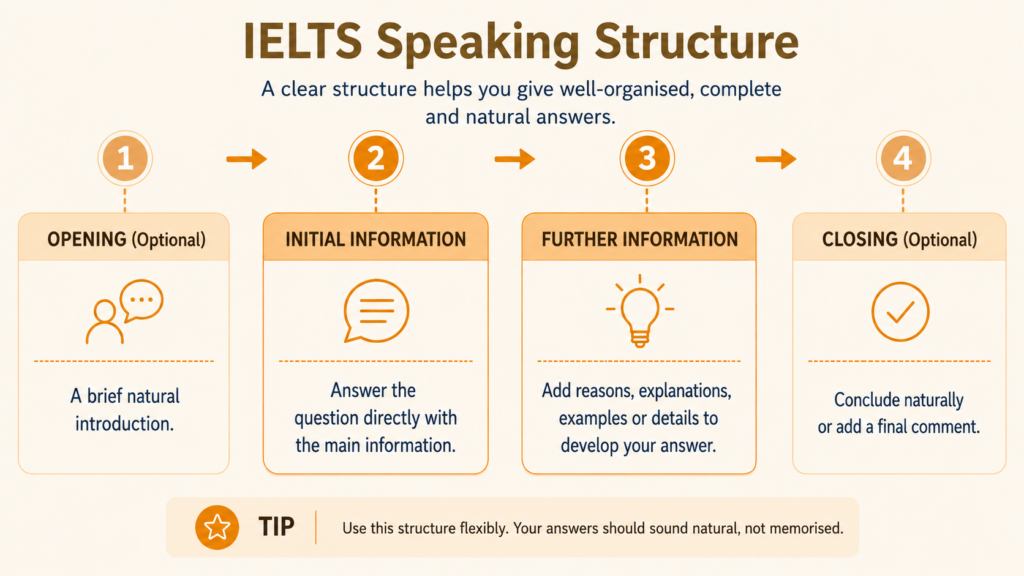
Question: Do you like listening to music on a regular basis?
Answer:
- Opening (optional) – A brief natural introduction:
Yes, definitely.
…… - Initial Information – Directly answer the question:
I listen to music almost every day, usually when I’m driving or just relaxing at home.
…… - Further Information – Add reasons, explanations, or examples:
I’m mostly into pop and soft rock because they put me in a better mood, especially after a long day.
…… - Closing (optional) – Conclude naturally or add a final comment:
So yes, I’d say music is a pretty normal part of my daily life.
Developing your answers in this structured way helps you speak at length, organise your ideas clearly, and demonstrate the fluency required for higher band scores.
Begin your response with a brief opening if appropriate. While this step is optional, it often helps you sound more natural and confident. Next, answer the question directly. After that, extend your answer by providing reasons, explanations, or examples. This is the most important part of your response because it demonstrates your ability to speak at length and develop ideas clearly. Finally, you may conclude your response naturally, although this step is optional.
You may skip the opening and closing if necessary, but the core of your answer must include two essential elements:
- Initial Information – A clear initial response to the question.
- Further Information – Further development through explanation or detail.
A useful technique is the “two-step process.” First, provide an initial piece of information that directly answers the question. Then, expand on it by adding further information. This shows that you fully understand the question and can develop your ideas effectively.
The length of your answer depends on your ability to generate and organise ideas. If you run out of ideas after one or two sentences, it is better to stop naturally rather than continue speaking aimlessly, which may lead to hesitation or unnecessary pauses. However, if you have relevant ideas, develop them as clearly and fully as possible.
Do not worry about speaking for too long — the IELTS examiner will stop you when appropriate.
Finally, remember that fluency does NOT mean speaking quickly. Speaking too fast can negatively affect clarity and pronunciation. You should aim to speak at a natural pace — neither too fast nor too slow — while maintaining clear articulation and steady rhythm.
Let us reconsider the previous example:
Audioscript
Question:
Do you like listening to music on a regular basis?
Answer 1 (Limited):
Yes, definitely. I listen to music almost every day. Usually, when I’m driving or just relaxing at home. I’m mostly into pop and soft rock. They put me in a better mood, especially after a long day. I’d say music is a pretty normal part of my daily life.
Answer 2 (Improved):
Yes, definitely. I listen to music almost every day, usually when I’m driving or just relaxing at home. I’m mostly into pop and soft rock because they put me in a better mood, especially after a long day. So yes, I’d say music is a pretty normal part of my daily life.
Although both answers are fluent, the second response is more coherent. The ideas are logically connected using linking devices such as “because” and “so”, which create smoother transitions between sentences.
Some candidates believe that speaking fluently is enough. However, high band scores require both fluency and coherence.
What Does “Coherence” Mean?
Coherence refers to the logical connection between your ideas. It involves:
- Using cohesive devices (e.g., however, moreover, therefore, all in all)
- Using discourse markers (e.g., in my opinion, as far as I’m concerned)
- Using pronoun references (e.g., it, they, this, these) to avoid repetition
When your ideas are clearly connected, your speech sounds more natural and organised.
Avoid Padding
Another important strategy for improving Fluency and Coherence is avoiding padding.
Padding means adding unnecessary words, fillers, or long lists simply to make your answer longer.
Consider this example:
Audioscript
Question:
Are there any fruits or vegetables you don’t like?
Limited Answer:
Yes, I don’t like onions, garlic, broccoli, uhh… cauliflower, mmm… and…
In this case, the long list makes the response sound unnatural. It also increases the risk of hesitation if you cannot think of more items.
Instead, limit your answer and develop it properly:
Audioscript
Question:
Are there any fruits or vegetables you don’t like?
Improved Answer:
Yes, there are. I’m not a fussy eater, but I really dislike onions and garlic. I usually avoid dishes that contain them because I don’t enjoy their strong flavour.
This response is clearer, more natural, and better developed.
Key Strategies to Improve Fluency and Coherence
To improve your FC score:
- Avoid hesitation (pauses) and unnecessary repetition
- Avoid padding and excessive listing
- Minimise noticeable self-correction
- Use linking words naturally
- Use pronoun references to connect ideas
Clear organisation and logical linking also support grammatical control, which can positively influence your overall performance. However, remember that Grammatical Range and Accuracy is assessed separately.
2. Lexical Resource (LR)
Lexical Resource accounts for 25% of your total IELTS Speaking band score. This criterion evaluates the range, precision, flexibility, and appropriacy of the vocabulary you use during the test.
It is not about using “big” or overly difficult words. It is about using the right words naturally, accurately, and appropriately.
What Does Lexical Resource Assess?
The examiner evaluates whether you can:
- Use a wide range of vocabulary appropriately
- Use less common vocabulary naturally and accurately
- Paraphrase effectively when needed
- Avoid unnecessary repetition
- Use collocations correctly
- Maintain precision in word choice
- Demonstrate flexibility in expressing the same idea in different ways
High-scoring candidates are able to reformulate ideas smoothly and use vocabulary that fits the context naturally.
Example: Limited vs Strong Lexical Resource
Audioscript
Question:
Do you enjoy travelling?
Limited Answer:
Yes, I like travelling. It is very good. I like visiting good places and meeting good people.
This response shows repetition and a limited vocabulary range.
Audioscript
Question:
Do you enjoy travelling?
Improved Answer:
Yes, I absolutely love travelling. It gives me the opportunity to explore new cultures, try different cuisines, and broaden my perspective. I find it both refreshing and educational.
The second response demonstrates:
- Greater lexical range
- More precise word choice
- Natural collocations (explore new cultures, broaden my perspective)
- More expressive and flexible vocabulary
Common Lexical Mistakes
- Overusing basic words (good, bad, very, thing, stuff)
- Misusing advanced vocabulary
- Using memorised phrases inappropriately
- Incorrect collocations (e.g., “do a mistake” instead of “make a mistake”)
- Using overly academic vocabulary in a natural spoken context
Remember: inaccurate advanced vocabulary can reduce your score more than simple but correct language.
How to Improve Your Lexical Resource
To improve your LR score:
- Learn vocabulary in context, not in isolation
- Study common IELTS topic areas (work, education, environment, technology, travel, health, etc.)
- Focus on natural collocations and word combinations
- Practise paraphrasing questions before answering
- Record yourself and identify hesitation or repetition
- Replace vague words with more precise alternatives
- Use appropriate phrasal verbs and natural spoken expressions
For example:
- very good → excellent / outstanding
- very bad → terrible / unacceptable
- very interesting → fascinating / engaging
However, you do not need to use overly academic or complex vocabulary. The Speaking test assesses natural conversational English, not formal academic writing. It is always better to use simple vocabulary accurately than to use sophisticated words you are unsure about.
Important Warning: Avoid Memorised Language
Memorising long, complex phrases may sound impressive, but examiners are trained to recognise unnatural language. If vocabulary does not fit the context naturally, it can negatively affect your score.
Your goal is not to impress the examiner.
Your goal is to communicate clearly, naturally, and accurately.
What If You Forget a Word while speaking?
Forgetting a word while speaking is completely normal — even native speakers experience this.
If it happens during the test:
- Do not panic.
- Do not freeze while trying to remember the exact word.
- Maintain fluency.
Instead, paraphrase.
You can:
- Use a synonym
- Describe the word
- Explain its function
- Give an example
For example, if you forget the word “microwave”, you could say:
“It’s a machine you use to heat food quickly.”
This strategy helps you maintain fluency and demonstrates vocabulary flexibility — both of which positively influence your Lexical Resource score.
3. Grammatical Range and Accuracy (GRA)
Grammatical Range and Accuracy account for 25% of your total IELTS Speaking band score. This criterion evaluates the variety of grammatical structures you use and how accurately you use them while speaking.
It is not about using extremely complex grammar all the time. It is about using a range of grammatical structures accurately, appropriately, and naturally.
What Does Grammatical Range and Accuracy Assess?
The examiner evaluates whether you can:
- Use a variety of sentence structures
- Combine simple and complex sentences effectively
- Control verb tenses accurately
- Use conditionals correctly
- Use relative clauses naturally
- Maintain subject–verb agreement
- Use articles and prepositions accurately
- Avoid frequent grammatical errors
Higher band scores require both:
- Range — variety of grammatical structures
- Accuracy — correct and appropriate usage
You must demonstrate both to achieve Band 7 or higher.
Understanding Accuracy: Form vs Use
Accuracy in grammar has two important aspects:
1️⃣ Form
This refers to the structure of the grammar.
For example, the form of the present continuous tense is:
am/is/are + verb + -ing —> am working
2️⃣ Use
This refers to whether the tense is appropriate in context.
Consider this sentence:
I’m working in London for around 3 months.
Here, the form of the present continuous is correct. However, the “use” is incorrect.
Because the sentence includes a duration (for around 3 months), the correct tense is the “present perfect continuous” (have/has + been + verb + -ing):
I’ve been working in London for around 3 months.
In IELTS Speaking, even if the form is correct, incorrect usage will reduce your accuracy score.
Example: Limited vs Strong Grammatical Range
Audioscript
Question: Do you enjoy studying English?
Limited Response:
Yes, I enjoy studying English. English helps me communicate with people from other countries. It is sometimes difficult. I feel happy when I see my progress.
Improved Response:
Yes, I enjoy studying English because it helps me communicate with people from other countries. Although it is sometimes difficult, I feel happy when I see my progress.
The first response uses only simple sentences.
The second response demonstrates:
- Complex sentences
- Subordinate clauses (because, although, when)
- Better sentence variety
- Stronger grammatical control
What Is Considered “Range”?
To demonstrate grammatical range, you should be able to use:
- Different tenses (past, present, future)
- Conditional sentences (If I …, I …)
- Relative clauses (which, who, that)
- Comparatives and superlatives
- Passive voice (when appropriate)
- Direct speech (when natural)
- Compound and complex sentence structures
Using subordinate clauses helps extend your ideas and create more sophisticated sentence structures.
However, do not force complex grammar unnaturally. Accuracy is more important than complexity.
A Useful Strategy:
👉 Follow the Grammar in the Question
A simple technique to improve accuracy is to listen carefully to the grammatical structure in the examiner’s question.
For example:
How has technology affected the way we communicate?
The question uses the present perfect.
Your answer will most likely need the present perfect as well.
Following the tense used in the question reduces the risk of grammatical inconsistency.
Common Grammatical Mistakes
- Incorrect verb tenses
- Subject–verb agreement errors
- Article misuse (a, an, the)
- Incorrect prepositions
- Overusing simple sentences
- Attempting complex structures incorrectly
Accuracy vs Complexity
Many candidates believe they must use very advanced grammar to achieve a high score. This is NOT true.
- Band 6: Mix of simple and complex structures, but noticeable errors
- Band 7: Frequent use of complex structures with generally good control
- Band 8+: Wide range of structures with rare minor errors
Do not memorise complicated grammar patterns in an attempt to impress the examiner. It is better to use a slightly simpler structure correctly than to attempt a complex one incorrectly.
Practical Strategies to Improve GRA
To improve your Grammatical Range and Accuracy:
- Practise combining short sentences into complex ones
- Learn and practise common linking clauses (because, although, while, if)
- Review tense consistency
- Record yourself and identify recurring grammar mistakes
- Seek professional correction
- Avoid overcomplicating your grammar
When you combine variety with accuracy, your GRA score improves significantly.
4. Pronunciation (P)
Pronunciation accounts for 25% of your total IELTS Speaking band score. This criterion evaluates how clearly and naturally you speak, and how easy it is for the examiner to understand you.
Pronunciation is NOT about having a British or American accent. IELTS is an international test, and you may speak with any accent. You are not assessed on accent — you are assessed on clarity and intelligibility.
Although all four criteria carry equal weight, pronunciation plays a crucial role in overall communication. Imagine speaking fluently and using a wide range of vocabulary and grammar, but the examiner cannot understand you clearly. Communication breaks down. Clear pronunciation supports all other areas of performance.
What Does Pronunciation Assess?
The examiner evaluates five key areas:
- Individual sounds
- Word stress
- Sentence stress
- Intonation
- Chunking (thought groups)
Together, these determine how natural and understandable your speech is.
1️⃣ Individual Sounds
Individual sounds refer to how accurately you pronounce specific consonants and vowels.
Some English sounds do not exist in many other languages. A common example is the “th” sound, which has two variations:
- /θ/ as in think
- /ð/ as in they
These sounds occur in fewer than 10% of the world’s languages. As a result, some learners replace them with the closest sounds in their own language. For example, “think” may be pronounced as “tink” or “sink”, and “they” may be pronounced as “day” or “zay”.
- “think” —> “tink” or “sink”
- “they” —> “day” or “zay”
To produce these sounds correctly, place the tip of your tongue lightly between your top and bottom teeth and allow air to pass through.
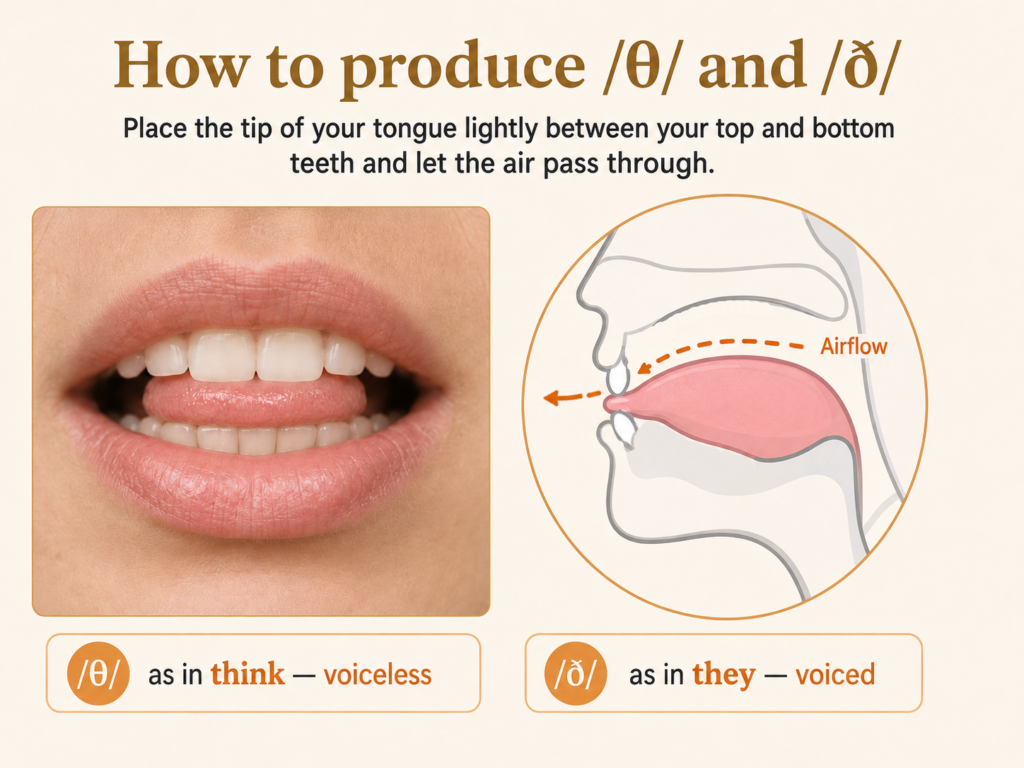
Mispronouncing individual sounds can cause misunderstanding, which directly affects your score.
2️⃣ Word Stress
Word stress means emphasising one syllable in a word more strongly than the others.
For example:
INteresting (correct)
inteRESTing (incorrect)
Incorrect word stress is common because learners often transfer stress patterns from their first language.
Stress can also change depending on part of speech:
REcord (noun)
reCORD (verb)
Example:
They went to a REcord company to reCORD their new album.
Incorrect word stress can make even correctly pronounced words difficult to understand.
3️⃣ Sentence Stress
Sentence stress refers to emphasising important words in a sentence.
In English, content words (nouns, verbs, adjectives, adverbs) usually receive stress, while function words (a, the, to, of) are weaker.
I WENT to the SUPERmarket to BUY some FRESH VEGEtables.
Normally, sentence stress falls on the words that carry important meaning or information, for example, I LOVE you. We typically stress “LOVE” to show its importance as well as our emotions. However, the stressed word can change depending on the specific meaning the speaker wants to communicate.
Consider this situation:
Tom has a girlfriend, Susan. She says:
Susan: We need to break up. I wanna marry John.
Tom: I love you, not John. Please marry me.
Now imagine a different situation. Susan is suspicious about Tom’s relationship with a colleague and keeps complaining.
Tom: Stop talking about this. I love YOU, not anyone else.
The meaning changes depending on which word is stressed:
- I LOVE you. (emphasising emotion)
- I love you. (emphasising the subject: I, not John)
- I love YOU. (emphasising the object: YOU, not someone else)
Sentence stress adds meaning, contrast, and emotion to speech. Without appropriate stress, speech can sound flat and robotic, even if the grammar and vocabulary are correct.
4️⃣ Intonation
Intonation is the rise and fall of your voice.
The two most common patterns are:
Rising Intonation
The voice rises at the end of the sentence. Often used in yes/no questions:
Have you studied enough for IELTS?
Falling Intonation
The voice falls at the end of the sentence: Common in:
- WH-questions: How much have you studied?
- Statements: I have studied enough.
- Commands: Please study more.
There is also a rise–fall pattern, often used for:
- Lists: I enjoy jogging, hiking, and camping.
- Choices: Would you like tea or coffee?
- Conditional sentences: If you have any questions, let me know.
Natural intonation makes your speech easier to follow and more engaging.
5️⃣ Chunking (Thought Groups)
Chunking refers to grouping words into meaningful units with natural pauses.
Compare these three versions:
❌ No chunking (too fast, unclear)
Well I was thinking about going to the store to buy some groceries for dinner tonight I need to pick up some chicken fresh vegetables and pasta but before I do that I need to drop off the dry cleaning at the cleaners.
❌ Incorrect chunking (too many unnatural pauses)
Well, I was thinking about, going to the store, to buy, some groceries, for dinner tonight…
✅ Natural chunking
Well, I was thinking about going to the store to buy some groceries for dinner tonight.
I need to pick up some chicken, fresh vegetables, and pasta.
But before I do that, I need to drop off the dry cleaning at the cleaners.
Chunking helps the listener process information clearly and logically.
Fluency vs Pronunciation
Many candidates confuse fluency with speed. Speaking quickly does not mean speaking well.
Speaking too fast can:
- Reduce clarity
- Affect word stress
- Distort pronunciation
- Increase grammatical errors
You should aim for a natural pace — neither too fast nor too slow.
How to Improve Your Pronunciation
To improve your Pronunciation score:
- Shadow native speakers (listen and repeat immediately)
- Record yourself and listen critically
- Compare your speech with native audio
- Read aloud regularly
- Focus on problematic sounds in your first language
When your pronunciation allows the examiner to understand you effortlessly, your score improves significantly.
Connected Speech
There are additional pronunciation features that make your speech sound more natural and native-like. One of the most important is connected speech.
Connected speech refers to the way words naturally flow together in spoken English. When we speak, we do not pronounce every word separately and clearly. Instead, sounds blend, link, or change slightly to create smooth and continuous speech.
It is called *connected speech* because the sounds of one word often connect directly to the sounds of the next.
The most common connected speech processes are:
* Catenation (linking)
* Elision
* Assimilation
1️⃣ Catenation (Linking)
Catenation occurs when the final consonant sound of one word links to the initial vowel sound of the next word.
For example:
meet up → /miːt ʌp/ (sounds like “mee-tup” /miːtʌp/)
turn off → /tɜːn ɒf/ (the /n/ links smoothly to /ɒ/ —> /tɜːnɒf/)
Instead of pronouncing two clearly separated words, native speakers produce them as one smooth unit. This makes speech faster and more natural.
2️⃣ Elision
Elision occurs when a sound is omitted in fast, natural speech. For example:
next day → /neks deɪ/ (the /t/ is often dropped)
most common → /məʊs kɒmən/ (the /t/ may disappear)
friendship → /frenʃɪp/ (the /d/ may disappear)
Elision makes pronunciation easier and more efficient in rapid speech.
Important correction:
“going to” becoming “gonna” is not strictly elision — it is a reduction and contraction common in informal spoken English.
3️⃣ Assimilation
Assimilation happens when one sound changes to become more like a neighbouring sound.
For example:
handbag → “hambag”
(/ndb/ becomes /mb/ for easier pronunciation)
don’t you → “donchu”
(/t/ + /j/ becomes /tʃ/)
would you → “woudju”
(/d/ + /j/ becomes /dʒ/)
Assimilation makes speech smoother and easier to produce.
Why Is Connected Speech Important?
Understanding connected speech is essential for:
* Listening comprehension
* Natural-sounding pronunciation
* Smooth, flowing speech
It is particularly important in Listening, because native speakers use these patterns constantly.
In Speaking, you do not need to force connected speech. However, using it naturally creates:
* Better rhythm
* More natural fluency
* Smoother delivery
This contributes positively to your Pronunciation score.
Contractions
Using contractions also makes your speech sound more natural:
will not → won’t
I am → I’m
do not → don’t
Native speakers rarely pronounce every word in full form during casual speech. Appropriate contractions support natural rhythm and connected speech.
Important Note
Do not exaggerate connected speech or force it artificially. It must sound natural. If overdone, it can reduce clarity.
The goal is:
* Clear
* Natural
* Intelligible
* Smooth
When your speech flows naturally without sounding robotic or overly careful, your Pronunciation score improves.
How to Perform Well on the Speaking Test (Exam Day Strategy)
This section is extremely important if you want to achieve a high band score in IELTS Speaking.
Below are practical strategies to help you manage your performance, reduce stress, and maximise your score on exam day.
1️⃣ Stay Relaxed
The most important advice is simple:
**Stay calm.**
When candidates feel nervous, their performance drops. Anxiety can affect fluency, memory, pronunciation, and clarity.
Glossophobia — the fear of public speaking — is very common. Studies suggest that a large proportion of people experience anxiety in speaking situations such as interviews, presentations, or exams.
The good news is that speaking anxiety can be managed.
The most effective technique is preparation:
* Practise answering common IELTS questions
* Record yourself
* Analyse your performance
* Identify hesitation, grammar errors, and pronunciation weaknesses
Regular practice builds familiarity. Familiarity builds confidence. Confidence reduces anxiety.
2️⃣ Understand the Examiner’s Role
IELTS examiners are trained to be professional, neutral, and supportive.
They are not testing:
* Your intelligence
* Your general knowledge
* Your academic expertise
They are assessing your ability to communicate in English.
There are no “right” or “wrong” opinions in Speaking. The examiner evaluates language performance, not your ideas.
Treat the test as a structured conversation. Smile naturally, maintain appropriate eye contact, and speak in a relaxed but respectful manner.
Speaking with natural expression and engagement improves communication and helps your delivery sound more authentic.
3️⃣ Made a Mistake? Do Not Panic.
Mistakes are normal.
If you stop repeatedly to correct every small error, your FC score will suffer.
If you notice a minor mistake and can correct it naturally, do so briefly and continue speaking.
For example:
“I have been living here for five year— sorry, five years.”
That type of quick correction is acceptable.
However, do not constantly interrupt yourself. Excessive self-correction reduces fluency.
Examiners expect occasional errors — even native speakers make them.
Minor mistakes that do not interfere with meaning will not significantly lower your score.
4️⃣ Can You Ask for Repetition or Clarification?
Yes — and it does not reduce your score if used appropriately.
In Part 1 and Part 2:
You may ask for repetition if you did not hear the question clearly.
Example:
“Sorry, could you repeat the question, please?”
In Part 3:
You may ask for:
* Repetition
* Clarification
* Explanation of a word
Examples:
“I’m sorry, could you clarify what you mean?”
“I’m not sure I understood the question. Could you explain it again?”
This does not negatively affect your band score. In fact, it shows natural communication strategies.
However, do not overuse this strategy unnecessarily.
5️⃣ What If the Question Is Difficult?
You are not expected to be an expert on every topic.
If you receive a challenging question:
* Buy time naturally
* Paraphrase the question
* Connect it to something you know
* Use personal experience
* Or make a reasonable assumption
For example:
Question: What do you think about the future of artificial intelligence?
Possible Response Strategy:
“That’s quite an interesting question. If you mean how AI might develop in the future, I’m not an expert in technology, but based on what I’ve read and seen, I believe it will become more integrated into healthcare and automation.”
You have:
* Paraphrased
* Bought thinking time
* Given a balanced response
The examiner does not care about your prediction of AI.
They care about your language performance.
6️⃣ Manage Stress Through Body Language
There is a strong connection between physical behaviour and mental state.
* Sit comfortably
* Maintain natural posture
* Avoid rigid tension
* Use natural facial expressions
When your body is relaxed, your speech becomes smoother and more controlled.
Final Reminder
On exam day:
* Stay calm
* Speak clearly
* Do not overthink mistakes
* Develop your answers naturally
* Focus on communication
IELTS Speaking is not a knowledge test. It is a communication test.
The 3 Parts of the IELTS Speaking Test
The IELTS Speaking test consists of three parts. Understanding what happens in each part will help you feel more confident and prepared on exam day.
The test lasts between 11 and 14 minutes in total:
Part 1: Introduction and Interview (4–5 minutes)
Part 2: Individual Long Turn (3–4 minutes)
Part 3: Two-way Discussion (4–5 minutes)
On exam day, you must bring the same identity document you used for your IELTS registration. If you fail to provide the correct ID, you may not be allowed to take the test.
Now, let’s examine each part in detail and learn how to approach them strategically.
Speaking Part 1: Introduction and Interview
Part 1 begins with the examiner introducing themselves and asking you to confirm your identity.
This section is often considered a “warm-up.” You will be asked questions about familiar topics such as:
* Your home
* Your family
* Your hometown
* Work or studies
After that, the examiner will ask questions on two additional everyday topics, such as:
* Food
* Travel
* Hobbies
* Sports
* Daily routines
You may receive around 8–12 questions in total.
How to Approach Part 1
* Answer naturally and confidently
* Respond quickly but clearly
* Do not overcomplicate your language
* Use appropriate tense based on the question
Part 1 questions are informal and personal. There is NO need for academic vocabulary.
Length of Answers
Typically, 2–3 well-developed sentences are enough.
If your answer becomes too long, the examiner will interrupt you and move to the next question. That is completely normal.
Speaking Part 2: The Individual Long Turn
After Part 1, you move to Part 2.
In this section, you must speak for up to 2 minutes on a given topic.
You will receive:
* A cue card with a topic
* 3–4 bullet points
* A final instruction asking you to explain something
Describe a shop or a store you often go to.
You should say:
- where it is
- what type of people go there
- what types of goods are sold there
and explain why you go there and what you like/dislike most about it
You will have 1 minute to prepare and take notes.
Important Clarification
Topics are general and non-sensitive. They are not about politics, religion, or controversial issues.
How to Prepare During the 1 Minute
* Read the topic quickly
* Identify the main idea
* Jot down **keywords only**
* Do not write full sentences
* Write in English, not your native language
Writing full sentences wastes time and may cause hesitation while speaking.
Keywords help you maintain structure without sounding scripted.
It is also useful to write:
Topic-specific vocabulary
One or two strong expressions
Consider this sample plan:
Describe a shop or a store you often go to.
You should say:
- where it is
- what type of people go there
- what types of goods are sold there
and explain why you go there and what you like/dislike most about it
Sample plan:
Main topic
shop/store
Location:
2 mins from home / city centre / near metro
People:
families / elderly / students
Goods:
fresh veg / bakery / imported food / household items
Why go:
convenient / reasonable prices / friendly staff
Like most:
wide variety / open late
Dislike:
crowded weekends
While Speaking
* Do not read your notes
* Do not read the bullet points aloud
* Speak naturally
* Keep going until the examiner stops you
The examiner will not interrupt you during your main speech unless time is up.
You may be asked 1 or 2 short follow-up questions after your long turn.
Do You Have to Cover All Bullet Points?
No.
The bullet points are a guide, not a checklist. You should stay relevant to the topic, but you do not need to address every bullet point equally.
However, you must stay generally on topic. You cannot speak about something completely unrelated.
Practice Advice
Before the exam:
* Time yourself
* Practise speaking for a full 2 minutes
* Train yourself not to stop early
Part 2 strongly tests your ability to speak at length.
Speaking Part 3: Two-Way Discussion
Part 3 is a deeper discussion related to the Part 2 topic.
This section tests:
* Abstract thinking
* Analysis
* Opinion justification
* Generalisation
Unlike Parts 1 and 2, Part 3 questions are:
* More complex
* More abstract
* About society, not just you
Instead of talking about your personal experience, you should discuss broader ideas.
However, you may briefly include personal examples to support your opinion.
Length of Answers
Answers in Part 3 should be longer than Part 1.
Aim for:
4–6 well-developed sentences
The examiner will interrupt if necessary.
Types of Part 3 Questions
There are generally two main types:
1️⃣ Opinion Questions
Example:
Do you think cooking is a pleasure or a burden for most people?
2️⃣ Solution / Suggestion Questions
Example:
How can we encourage people to use public transportation?
After your main answer, the examiner will often ask follow-up questions such as:
* Why do you think that?
* Can you explain further?
* Can you give an example?
This does NOT mean your answer was weak.
It simply allows the examiner to evaluate your ability to develop ideas.
Can You Ask for Clarification in Part 3?
Yes.
In Part 3, you may ask the examiner to:
* Repeat
* Clarify
* Rephrase
Examples:
“Could you clarify the question, please?”
“Could you explain what you mean by that?”
This does not lower your score if used appropriately.
Final Strategic Advice
Part 1 → Be natural and confident
Part 2 → Speak at length and stay organised
Part 3 → Analyse and justify your ideas
IELTS Speaking is not a knowledge test. It is a communication performance test.
Thank you for studying this lesson. If you have any questions about the IELTS Speaking test, feel free to leave a comment below.